

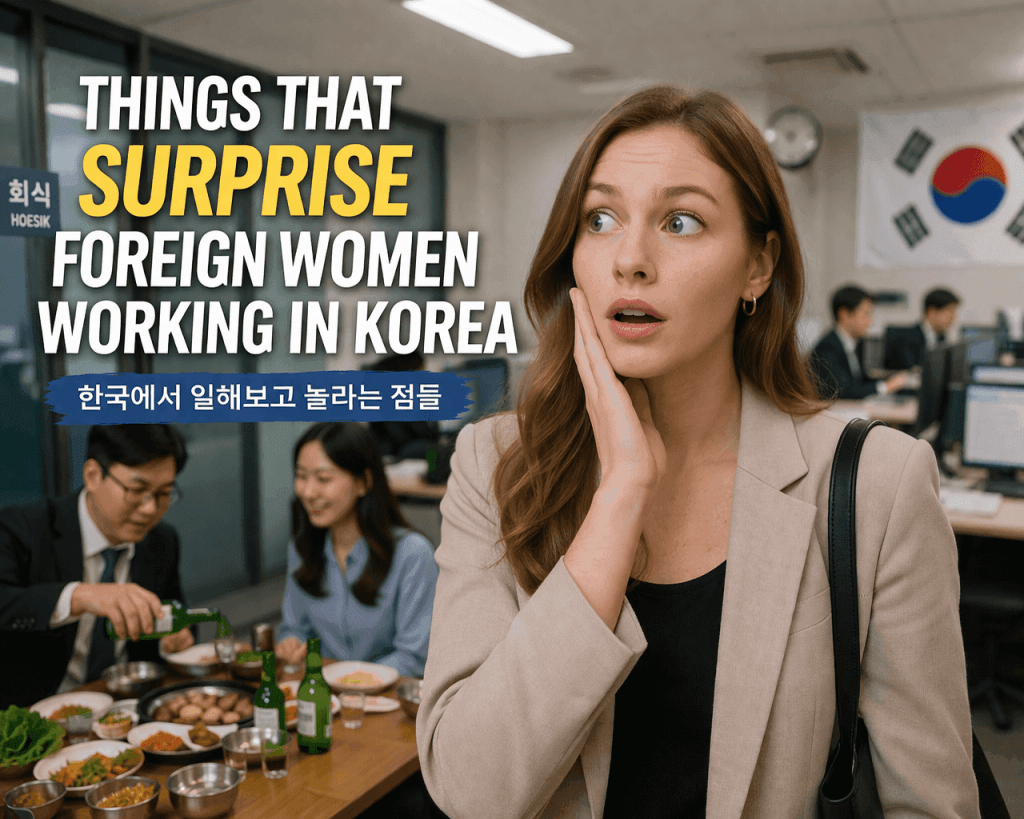
Gender & Work • Korea • Culture Shock
Things That Surprise Foreign Women Working in Korea
Working in Korea can feel familiar at first—but for many foreign women, the real surprises come after the first few weeks.
Why working in Korea feels different
On the surface, offices in Korea don’t look that different from anywhere else. Meetings, emails, deadlines— everything seems normal. But once you actually start working, subtle differences begin to stand out.
Especially for foreign women, these differences are not always obvious at first—but they become very real over time.
“It’s not the job itself. It’s how the workplace operates.”
1) Hierarchy is stronger than expected
In many countries, workplaces are becoming more horizontal. In Korea, hierarchy is still a strong part of daily work life.
2) After-work culture is part of the job
One of the biggest surprises is that work doesn’t always end when office hours end.
For many foreign women, this feels less like social time and more like an extension of work.
3) Communication is more indirect
In Korea, communication is often less direct than in Western workplaces.
This can be confusing at first, especially when clarity is expected.
4) Work-life balance can feel different
Korea has improved a lot in recent years, but the culture of staying late still exists in many companies.
For foreign employees, this can feel like pressure—even when it’s not explicitly stated.
5) Gender expectations still exist
One of the more subtle surprises is how gender expectations can still influence workplace dynamics.
So why do many still choose to work in Korea?
01
Fast-paced environment
Things move quickly and decisions happen fast
02
Strong team culture
Once you adapt, relationships can be very strong
03
Career experience
Working in Korea is often seen as valuable global experience
Conclusion
Working in Korea is not just about doing your job—it’s about understanding how work fits into a broader social structure.
For foreign women, the biggest surprises are not always negative. They are simply different.
“Once you understand the system, it starts to make sense.”