

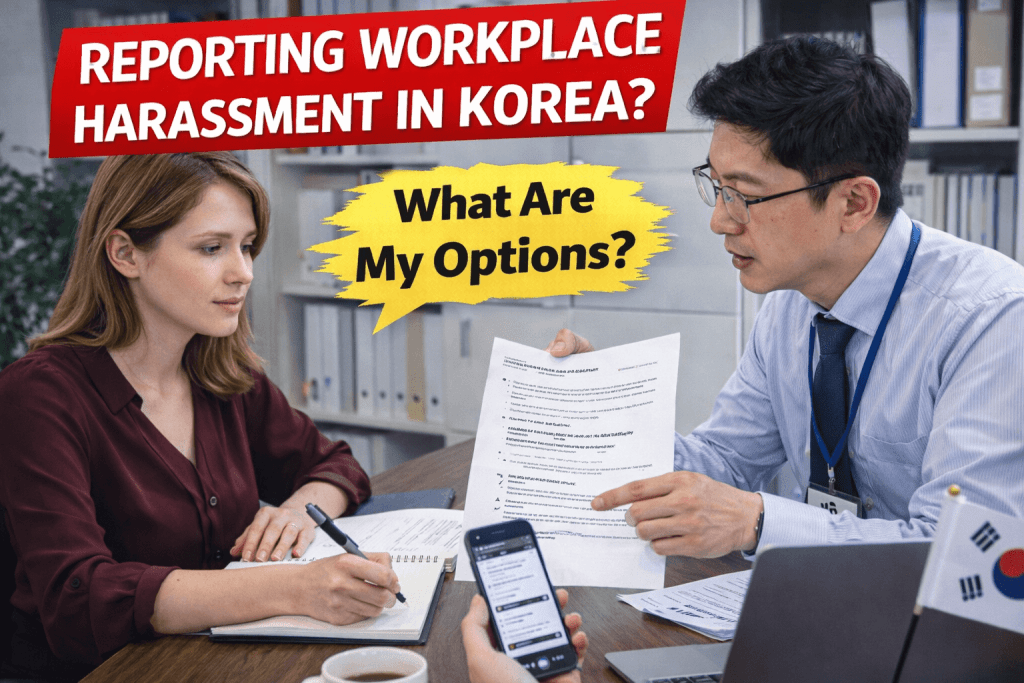
Workplace Harassment in Korea (For Foreign Employees): Step-by-Step Reporting, Evidence, and Real Outcomes
If you are experiencing bullying, intimidation, humiliation, or sexual harassment at work in Korea, this guide will help you respond calmly and strategically.
You will learn what counts as workplace harassment, what your employer is legally required to do, how to document evidence, where to report, and why reporting is not meaningless.
KR: “참아야 하나?”가 아니라, 기록하고 절차대로 움직이면 실제로 바뀌는 경우가 많습니다.
1) What Counts as Workplace Harassment in Korea?
Under Korea’s Labor Standards framework, workplace harassment refers to behavior that uses workplace superiority (position, hierarchy, control of tasks) to exceed appropriate work boundaries and cause physical or mental suffering, or significantly worsen the work environment.
Common patterns frequently reported
- Public humiliation, yelling, or insults during meetings
- Isolation from key projects or internal communication channels
- Impossible deadlines designed to cause failure
- Threats related to evaluation, contract renewal, or visa status
- Retaliation after raising a complaint
Harassment is often a pattern, not one dramatic moment. Patterns become powerful when documented clearly.
2) Employer Obligations (This Is Not Optional)
When an employer becomes aware of workplace harassment allegations, they are required to investigate promptly and take appropriate protective measures.
Signs of proper handling
- Written acknowledgement of your complaint
- Objective investigation process
- Temporary protective measures if needed
- Confidential handling of information
- Disciplinary or corrective action when confirmed
Important: Retaliation against someone who reports harassment can itself create additional legal risk for the employer.
3) Step-by-Step Action Plan
Step 1: Document Immediately
- Create a dated timeline
- Save messages and emails
- Keep records outside company devices if possible
Step 2: Confirm in Writing
After any verbal incident, send a neutral recap email summarizing what occurred.
Step 3: Report Internally
- Submit a formal complaint to HR or compliance
- Request written confirmation of next steps
Step 4: Escalate if Necessary
If internal processes fail, you may seek guidance from official labor authorities or the National Human Rights Commission of Korea.
4) Official Support Channels
- Ministry of Employment and Labor (MOEL) – Labor counseling and complaint filing support (phone counseling available).
- National Human Rights Commission of Korea (NHRCK) – Handles human-rights-based complaints including sexual harassment.
- Employment Equality Counseling Centers – Specialized support for gender-based workplace discrimination and harassment.
External reporting is not extreme. In many cases, it encourages proper investigation and faster resolution.
5) Evidence Checklist
- Employment contract and renewal history
- Written communications (email, messenger, task assignments)
- Meeting invitations before vs after incidents
- Performance reviews and sudden warnings
- Witness names
- Health impact documentation (if applicable)
A documented pattern carries more weight than isolated complaints.
6) Sexual Harassment in Korea
Sexual harassment in the workplace has been the subject of major legal reform in Korea. Courts and national institutions have recognized its seriousness, and formal complaint systems exist specifically to address it.
Outcomes can include corrective action, settlement, internal restructuring, and policy reform within organizations.
7) Low-Drama Email Templates
Template: Formal Report
Subject: Formal Report – Workplace Harassment Concern
Hello [HR Name],
I would like to formally report a workplace harassment concern.
Summary: [Brief description, dates involved]
Please confirm receipt of this report and outline the next steps in the investigation process.
Thank you.
Best regards,
[Your Name]
Template: Verbal Incident Recap
Subject: Follow-up Summary – [Date]
Hello [Name],
To confirm today’s discussion, my understanding is:
– [Fact 1]
– [Fact 2]
Please let me know if any part is inaccurate.
Best regards,
[Your Name]
8) Why Reporting Is Not Meaningless
- Harassers have been removed from supervisory positions.
- Companies have introduced new compliance systems.
- Formal complaints have resulted in documented corrective action.
- Human rights authorities have secured substantive remedies in many cases.
Reporting is not revenge. It is often the beginning of restoring a professional environment.
9) Final Checklist
- Create your timeline today
- Preserve evidence securely
- Request written confirmation of complaint receipt
- Ask for protective measures if needed
- Escalate if internal handling fails
You deserve a workplace free from intimidation and fear.