

GLOBAL PULSE · Payments & Culture
When Did We Stop Using Cash? – Cashless Societies
우리는 언제부터 현금을 거의 쓰지 않게 됐을까 — 현금이 사라진 나라 vs 아직도 현금이 중심인 나라
Cash didn’t vanish overnight. It quietly stepped back as cards, mobile wallets, and QR payments became the default.
현금은 어느 날 갑자기 사라진 게 아니다. 카드·모바일·QR 결제가 ‘기본값’이 되면서 조용히 뒷자리로 물러났다.
But the transition speed is wildly different by country.
다만 국가별 전환 속도는 극단적으로 다르다.
Cashless Leaders
Speed · Convenience
Places where cash has shifted from “main method” to “backup option.”
현금이 ‘주 결제 수단’이 아니라 ‘예비/예외 수단’으로 바뀐 국가들.
Sweden is often described as one of the most cash-light societies. Many merchants prefer digital payments, and cash is increasingly treated as a contingency tool.
스웨덴은 대표적인 ‘현금 희소 사회’로 자주 언급된다. 많은 매장에서 디지털 결제가 선호되며, 현금은 점점 ‘비상용’에 가까워졌다.
- What you feel: “Wallet-free” daily life is realistic in many cities.
체감: 도시권에서는 ‘지갑 없이도’ 생활이 가능하다고 느끼는 사람이 많다. - Why it happened: High trust + near-universal digital acceptance.
핵심 요인: 신뢰 + 높은 디지털 결제 수용성.
The Netherlands is frequently cited among Europe’s lowest cash-use countries for point-of-sale transactions. Even small purchases are often card-based.
네덜란드는 유럽에서 매장 결제 기준 현금 비중이 매우 낮은 국가군으로 자주 언급된다. 소액 결제도 카드가 기본인 경우가 많다.
- Everyday pattern: Tap-to-pay culture dominates.
일상 패턴: ‘찍고 끝’ 결제가 표준. - Behavior shift: Cash becomes “inconvenient” rather than “useful.”
변화: 현금이 ‘유용’이 아니라 ‘번거로움’으로 인식되기 시작.
Korea adopted cards early and accelerated with mobile payments. For many people, cash isn’t avoided — it’s simply unnecessary most days.
한국은 카드 확산이 빠른 편이었고 모바일 결제로 더 가속했다. 많은 사람들에게 현금은 ‘안 쓰는 것’이 아니라 ‘쓸 일이 없는 것’에 가깝다.
- Where it shows: Transport, cafés, delivery, convenience stores are digital-first.
특징: 교통·카페·배달·편의점까지 디지털 결제가 기본. - Cash role today: Occasional use (gifts, emergencies, niche cases).
현금의 역할: 선물/비상/특정 상황용으로 축소.
In many Chinese cities, QR is the social default — from street vendors to taxis. Cash is accepted, but it’s no longer the “natural” choice.
중국은 도시권에서 QR이 ‘사회적 기본값’이 된 사례가 많다. 노점부터 택시까지 QR이 자연스럽고, 현금은 받더라도 ‘기본 선택지’는 아니다.
- Network effect: Once everyone uses QR, the ecosystem locks in.
네트워크 효과: 모두가 쓰기 시작하면 생태계가 고정된다. - Traveler note: Visitors often feel the steepest gap here.
여행자 포인트: 외국인이 ‘현금 장벽’을 크게 느끼는 대표 케이스.
Cash-First Holdouts
Privacy · Control · Resilience
Countries where cash is not just payment — it’s trust, privacy, and psychological control.
현금이 단순 결제를 넘어 ‘신뢰·프라이버시·통제감’의 상징으로 남아 있는 국가들.
Germany is widely known for a strong cash culture. Even as digital payments rise, many people prefer cash for privacy and budgeting control.
독일은 현금 문화가 강한 국가로 널리 알려져 있다. 디지털 결제가 늘어도 프라이버시와 예산 통제 측면에서 현금을 선호하는 사람이 많다.
- Core value: “Cash = freedom / fewer traces.”
핵심 가치: “현금 = 자유 / 흔적이 적다.” - Behavior: Paying in cash feels more controllable.
행동: 현금 결제가 ‘통제 가능한 소비’로 느껴짐.
Japan is technologically advanced, yet cash historically represented certainty and readiness — especially in a disaster-aware society.
일본은 기술 강국이지만, 현금이 오랫동안 ‘확실함’과 ‘대비’의 상징이었다. 재난 대비 인식이 강한 사회적 맥락도 한몫했다.
- Transition: Cashless is growing fast, but cash still matters.
전환: 캐시리스가 커져도 현금의 존재감은 유지. - Why it persists: Habit + reliability mindset.
지속 요인: 습관 + 안정성 중심 사고.
India’s digital payments have grown rapidly, but cash remains crucial in informal economies and areas where financial access is uneven.
인도는 디지털 결제가 빠르게 성장했지만, 비공식 경제(현장 거래)와 금융 접근성이 고르지 못한 영역에서는 현금이 여전히 핵심이다.
- Where cash stays: Small merchants, rural areas, informal transactions.
현금이 남는 곳: 소상공인·농촌·비공식 거래. - Key driver: Inclusion + trust + infrastructure variance.
핵심 요인: 금융포용·신뢰·인프라 격차.
Vietnam is moving toward QR and mobile in cities, yet cash is still the default for markets, street food, and small shops.
베트남은 도시권에서 QR·모바일이 확산 중이지만, 시장·길거리 음식·소규모 상점에서는 현금이 여전히 ‘기본값’인 경우가 많다.
- Reality: Hybrid payments depending on district and merchant type.
현실: 지역/상권/업종에 따라 하이브리드. - What to watch: QR acceptance expansion among micro-merchants.
관전 포인트: 소상공인 영역의 QR 수용 확대.
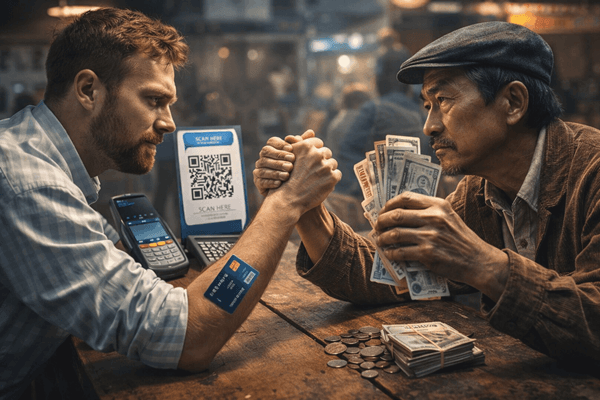
What separates the two worlds
Simple lens
Cash doesn’t “die” — it gets reassigned. From default → option.
현금은 ‘죽는’ 게 아니라 역할이 바뀐다. 기본값 → 선택지.
Convenience wins · 편의성이 이긴 사회
Fast acceptance + habit formation → cash becomes unnecessary.
수용성 + 습관 형성 → 현금이 ‘쓸모 없는’ 상태로 이동.
Control wins · 통제감이 남은 사회
Privacy, budgeting, resilience → cash remains psychologically safe.
프라이버시·예산·복원력 → 현금이 ‘심리적 안전장치’로 유지.
Phone-as-wallet · 휴대폰이 지갑이 된 순간
When identity + payment merged, cash lost its “default” seat.
인증+결제가 합쳐지며 현금의 기본값 자리에서 내려옴.
Trust shift · 신뢰의 이동
People started trusting networks more than paper.
사람들이 종이보다 ‘네트워크’를 더 신뢰하기 시작.
Cash didn’t end. It changed meaning.
Default → Option
Cashless countries optimize for speed and frictionless living. Cash-first countries keep cash as a tool for privacy, control, and “just in case.”
현금 비중이 낮은 나라는 속도와 마찰 없는 생활에 최적화되어 있고, 현금 중심 문화는 프라이버시·통제감·만약을 위한 장치로 현금을 남겨둔다.
The future isn’t “cash vs no cash.” It’s “what people trust most becomes the default.”
미래는 ‘현금이냐 아니냐’가 아니라, ‘사람들이 가장 신뢰하는 방식이 기본값이 되는 것’에 가깝다.