

K-Culture • Dating • Reality Check
The Ideal vs. The Reality: What K-Culture Admirers Discover About Korean Men
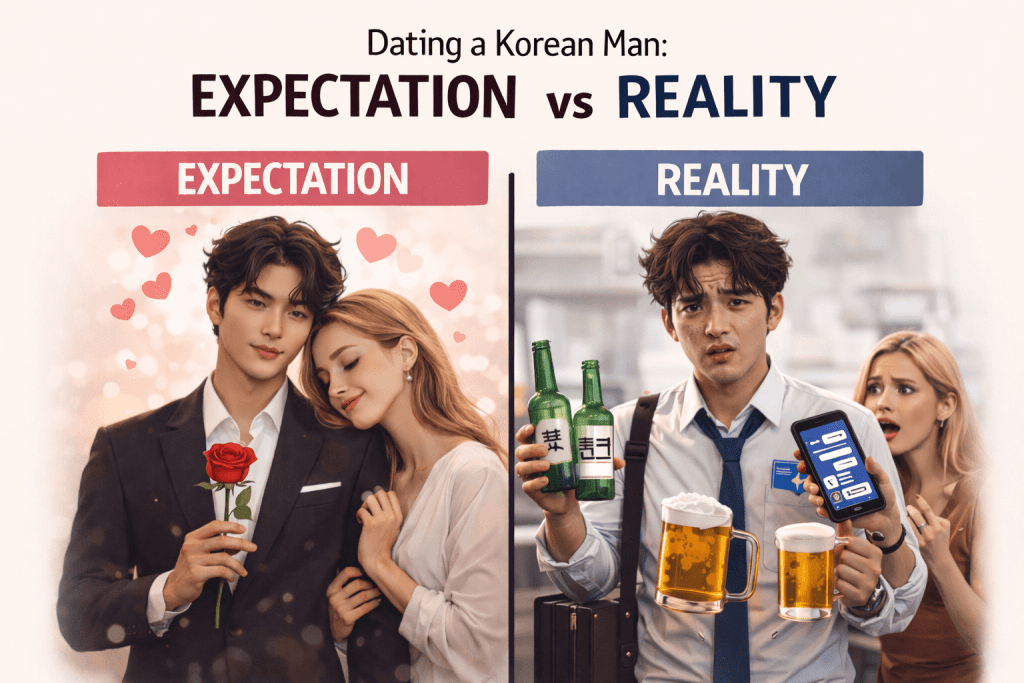
When the fantasy is already written, the first date isn’t the beginning—it’s the collision. Here’s the most common expectation gap foreign women describe after dating Korean men in real life.
1) The fantasy often starts before the relationship
For many women who admire K-dramas, K-pop, and Korean lifestyle content, “Korean men” are not blank slates. The image is already formed—cinematic romance, protective warmth, stylish confidence, and unwavering devotion.
But real life doesn’t come with background music. And the gap between genre and reality is where most misunderstandings begin.
“Sometimes you don’t fall for a person first—you fall for a genre.”
2) The expectation gap: what many assume vs. what they often experience
Common expectations
What the K-culture image suggests
Common reality feedback
What many meet in real dating
KR 메모: “표현이 적다 = 마음이 없다”로 바로 연결되기 쉬운데, 실제로는 ‘표현 방식’이 다를 뿐인 경우가 많아요.
3) Expectation: emotionally expressive • Reality: emotionally contained
Many expect romantic intensity. What they often meet is emotional restraint. Not necessarily coldness—more like a preference for stability, control, and indirect signaling.
What it can look like
Planning dates, checking in often, solving problems quickly, staying consistent.
How it can be interpreted
“He cares, but I don’t feel emotionally seen.”
4) Expectation: protective hero • Reality: competitive provider
The “protective Korean boyfriend” idea is powerful. But in reality, many Korean men are shaped by intense social competition, career pressure, and a strong provider mindset.
A key translation
In many cases, “protection” isn’t romance—it’s responsibility. That can feel attractive… or heavy, depending on what you want.
KR 한줄: 책임감은 매력이지만, 때로는 ‘숨막히는 진지함’으로 느껴질 수도 있어요.
5) Expectation: constant passion • Reality: routine stability
In dramas, love is urgent. In real life, routines form quickly—messaging becomes habit, affection becomes subtle, and “excitement” turns into “structure.”
The real question
Is your love language built for routine?
For some, stability feels safe and mature. For others, it feels like the romance is fading. The difference isn’t always the relationship—it’s the baseline expectation of how love should feel.
6) The “culture shock” moments that trigger the biggest misunderstandings
Social drinking & late-night work gatherings
It’s not just alcohol—often it’s belonging, hierarchy, and workplace bonding.
Faster marriage conversations
Compatibility, finances, and timeline discussions can appear earlier than many expect.
Conflict style feels “strong”
Direct problem-solving can be interpreted as harshness if you expect soft emotional validation first.
Indirect emotional communication
You may receive care as practical support, not verbal reassurance.
7) Why attraction often survives the reality check
Even after the fantasy fades, many relationships deepen—because what replaces it is consistency, reliability, and long-term thinking. The drama disappears. The structure remains.
01
Consistency
Showing up, following through, staying steady.
02
Clarity
Fewer ambiguous “situationship” phases.
03
Future mindset
Planning, budgeting, and real-world seriousness.
KR 메모: ‘설렘’은 줄어들어도 ‘신뢰’가 올라가면 관계는 오히려 더 단단해질 수 있어요.
Conclusion: the healthiest couples translate culture, not just feelings
A Korean man is not a K-drama character. He is shaped by military service, competition, hierarchy, family expectations, and constant social pressure to succeed.
When fantasy meets context, the relationship either collapses—or becomes more real than the drama ever was. The winning move is simple: explain meaning, not just emotion.
“The goal isn’t a K-drama boyfriend. The goal is a real partner—warm, consistent, and culturally transparent.”