

Why One Message in a Korean Apartment Group Chat Can Ruin Your Reputation
Korean apartment group chats often go viral not because of what is said, but because of how it’s said.
Elevators. Parking. Dogs. Kids.
In Korea, everyday complaints can turn into public trials.
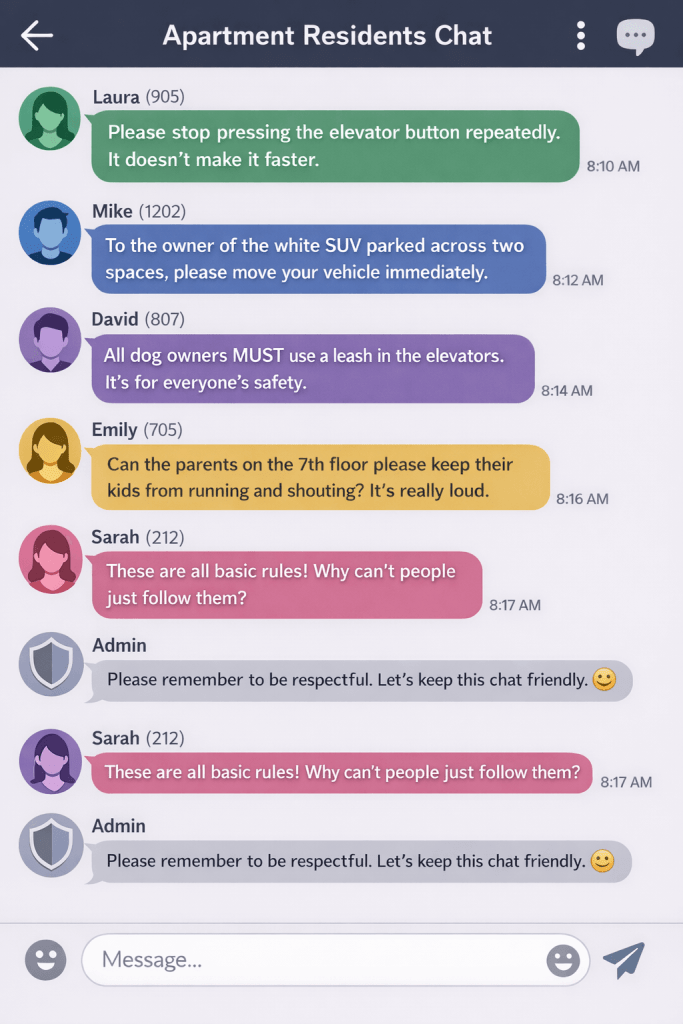
Elevators, parking, dogs, and children’s noise regularly trigger public judgment online.In Korea, apartment group chats are not boring. They are where everyday life quietly turns into public drama.
한국의 아파트 단톡방은 일상이 언제든 사건으로 바뀌는 공간입니다.
Over the years, ordinary messages about elevators, parking, pets, and children have gone viral—sometimes with brutal consequences.
엘리베이터, 주차, 반려견, 아이 소음 같은 일상 민원이 수없이 밈이 되어 퍼졌습니다.
Case 1: Elevator Etiquette Wars
This message appears in apartment chats every year. And every year, it explodes.
엘리베이터 버튼 관련 민원은 주기적으로 불타는 단골 소재입니다.
The problem isn’t the content—it’s the tone. It reads like a lecture from a stranger.
문제는 내용이 아니라, 훈계처럼 느껴지는 말투입니다.
Online commenters quickly reframe the sender as “that person who corrects everyone in elevators.”
작성자는 순식간에 ‘엘리베이터 꼰대’ 캐릭터로 소비됩니다.
Case 2: Parking Messages That Start Wars
Parking complaints feel justified. That’s exactly why they’re dangerous.
주차 민원은 ‘할 말은 맞다’는 점 때문에 더 쉽게 불붙습니다.
The moment apartment numbers or car descriptions appear, the chat turns into a guessing game.
동·호수나 차량 특징이 나오면, 단톡방은 추리극이 됩니다.
Screenshots escape the building. Now the driver isn’t just inconsiderate—they’re a meme.
캡처가 외부로 나가면, 주차자는 단순 민폐가 아니라 밈이 됩니다.
Case 3: Dogs, Elevators, and “Public Safety”
Few topics divide Korean apartments more than dogs. This message almost guarantees chaos.
반려견 문제는 아파트 단톡방에서 가장 민감한 주제 중 하나입니다.
Dog owners feel targeted. Non-owners feel validated. Nobody stays neutral.
견주는 공격받았다고 느끼고, 비견주는 정의가 실현됐다고 느낍니다.
What started as safety language quickly becomes a moral debate about responsibility.
안전 이야기는 곧 책임과 인성 논쟁으로 확장됩니다.
Case 4: Children’s Noise — The Nuclear Topic
No topic explodes faster than children’s noise. Parents and non-parents instantly take sides.
아이 소음 문제는 부모·비부모 진영이 즉각 갈리는 핵폭탄급 주제입니다.
Parents hear: “You are raising your child wrong.” Others hear: “Finally, someone said it.”
부모는 ‘양육 비난’으로, 다른 주민은 ‘사이다 발언’으로 받아들입니다.
Once this hits social media, the sender is often labeled “anti-children”—fair or not.
온라인으로 퍼지면 작성자는 순식간에 ‘아이 혐오’ 프레임에 갇힙니다.
Why These Messages Keep Going Viral
Korean apartment life combines forced proximity with intense expectations of harmony.
밀집 주거 환경과 조화에 대한 기대가 동시에 작동합니다.
Group chats remove facial expressions and tone of voice. All that remains is text—and judgment.
얼굴과 음성이 사라진 공간에서, 텍스트는 곧 판단의 재료가 됩니다.
Why Foreigners Are Always Shocked
“Why didn’t they just talk face-to-face?” is the most common reaction from outsiders.
외국인들이 가장 많이 던지는 질문입니다.
In Korea, writing feels safer. Screenshots make it permanent.
글은 안전하지만, 캡처는 영구 기록이 됩니다.
Final Thought
None of these people wanted attention. They wanted quiet, order, or fairness.
누구도 관심을 원하지 않았고, 그냥 질서 있는 일상을 원했을 뿐입니다.
In Korea, that’s exactly what makes these stories unforgettable.
그 평범함이 이 이야기들을 더욱 강렬하게 만듭니다.
One message. One screenshot. A public verdict.
문장 하나, 캡처 하나, 그리고 공개 판결.