

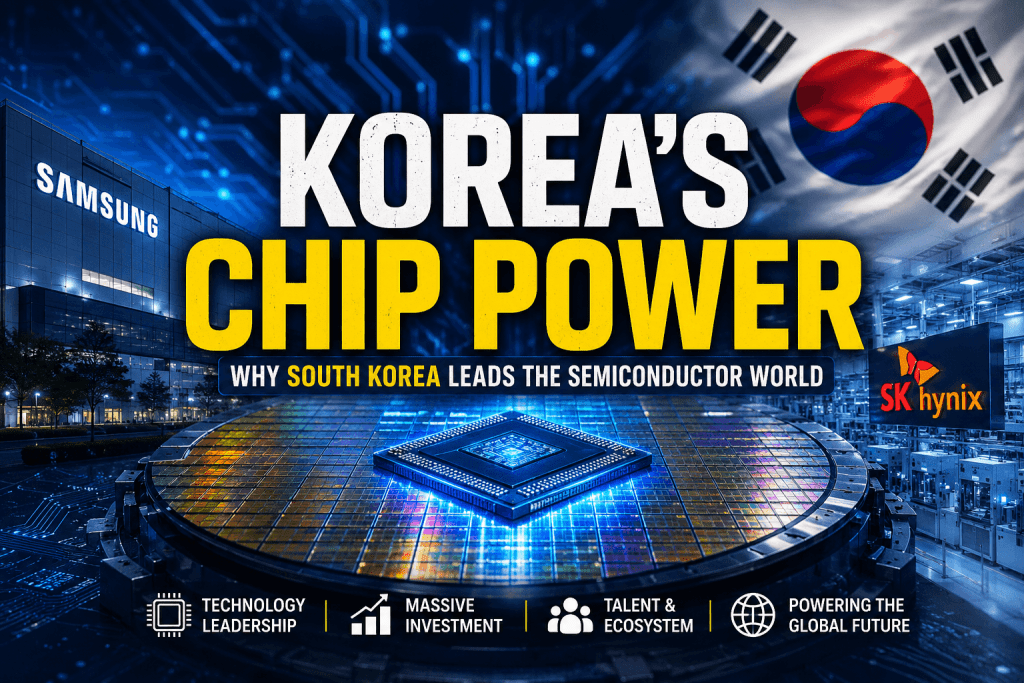
Korea • Technology • Semiconductor Industry
South Korea Semiconductor Industry: Why Is Korea So Strong in Chips?
South Korea is not only known for K-pop and K-dramas. It is also one of the most powerful countries in the global semiconductor industry.
Why the South Korea semiconductor industry matters
The South Korea semiconductor industry is one of the most important technology sectors in the world. Semiconductors power smartphones, laptops, cars, servers, artificial intelligence systems, and almost every modern digital device.
For many people outside Korea, the country is first associated with entertainment, food, beauty, or tourism. But behind the cultural wave, Korea also plays a critical role in the global technology supply chain.
“If chips are the oil of the digital age, Korea is one of the countries that knows how to refine them at scale.”
1) Korea became a memory chip powerhouse
Korea’s semiconductor strength is especially visible in memory chips. Memory chips store and move data, and they are essential for smartphones, PCs, data centers, and AI servers.
2) Samsung and SK hynix built global scale
Samsung Electronics
Scale, investment, and broad semiconductor capabilities
Samsung is one of the world’s most important semiconductor companies. Its strength comes from massive investment, advanced manufacturing, memory leadership, and a broad technology portfolio.
SK hynix
Memory focus and AI-driven momentum
SK hynix is another core player in Korea’s semiconductor rise. It has become especially important in advanced memory, including high-bandwidth memory used for AI computing.
Korea’s strength is not just that it has famous companies. It is that these companies can manufacture at enormous scale, improve technology generation after generation, and compete in one of the most capital-intensive industries on earth.
3) Korea is very good at precision manufacturing
Semiconductor manufacturing is not just “making small parts.” It requires extreme precision, process control, cleanroom discipline, advanced equipment, and highly trained engineers.
Process discipline
Small errors can destroy yield, so factories must operate with strict control and repeatability.
Engineering culture
Korean manufacturers have developed strong engineering teams focused on speed, yield, and problem-solving.
Mass production
Korea’s advantage is not only invention. It is the ability to produce advanced chips reliably at scale.
Continuous investment
Chip leadership requires huge long-term investment even before profits are guaranteed.
4) The ecosystem matters as much as the big companies
A semiconductor powerhouse cannot be built by one company alone. It needs suppliers, materials, equipment, chemical producers, logistics networks, universities, engineers, and government-level industrial support.
5) Korea took big risks before the market was obvious
One of the reasons Korea became strong in semiconductors is that companies made bold investments before success was guaranteed. Semiconductor factories cost billions of dollars, and each technology transition can be extremely risky.
Korea’s major chipmakers repeatedly invested through cycles of boom and bust. That long-term commitment helped Korea build experience, scale, and confidence that newer competitors cannot easily copy.
“In semiconductors, timing matters—but persistence matters even more.”
6) AI made Korean memory even more important
The rise of artificial intelligence has changed the way people think about memory chips. AI systems need enormous amounts of data movement, and that makes advanced memory technologies more valuable.
High-bandwidth memory, often called HBM, has become especially important for AI accelerators. This is one reason Korea’s memory leadership has become even more strategically important in the AI era.
01
AI servers
Need faster memory and higher bandwidth.
02
HBM
Has become a key part of advanced AI hardware.
03
Korean advantage
Korea already has deep memory manufacturing know-how.
Can Korea stay on top?
Korea’s position is strong, but the competition is intense. Taiwan is extremely strong in foundry manufacturing, the United States leads in many chip design and equipment areas, and China continues to invest heavily in semiconductor independence.
That means Korea cannot rely only on its past success. It must keep investing in next-generation memory, advanced packaging, AI-related chips, materials localization, and supply chain resilience.
Challenge
Memory cycles can be volatile and prices can swing sharply.
Opportunity
AI demand is making advanced memory more strategically valuable.
Risk
Geopolitics and supply chain restrictions can reshape global competition.
Next step
Korea needs to strengthen both memory leadership and broader semiconductor ecosystems.
Conclusion
Korea became a semiconductor powerhouse because it combined bold investment, manufacturing discipline, engineering talent, and a strong industrial ecosystem.
Samsung and SK hynix are the visible symbols of Korea’s semiconductor success, but the real story is bigger. It is about decades of accumulated know-how, risk-taking, supply chain development, and the ability to manufacture some of the world’s most advanced chips at scale.