

The cultural engine behind Korea’s fashion exports — where stage lights meet night markets, and taste is trained on data.

It starts with rhythm — and ends in revenue. Each time a K-Pop star drops a video, searches for “Korean fashion” jump within hours. After Dynamite (2020), global interest in “K-style outfits” surged +620%. By 2023, that curiosity mapped to USD 7.3B in apparel exports (KOTRA 2024). Fame is the spark; the system is the fire.
“Content lights the demand. Dongdaemun, data, and discipline turn it into delivery.”

From Screen to Cart
Hallyu is no longer a mood; it’s a mechanism. Content builds aspiration; aspiration becomes clicks; clicks convert to carts. That’s the working math behind K-Fashion’s export wave. The Sustainability study by Jin et al. (2024) quantified it — as the Hallyu Index rises, so do Korea’s consumer-goods exports, apparel included.
But fame alone doesn’t invoice. The conversion happens when creators’ heat meets a supply chain designed for speed and precision.
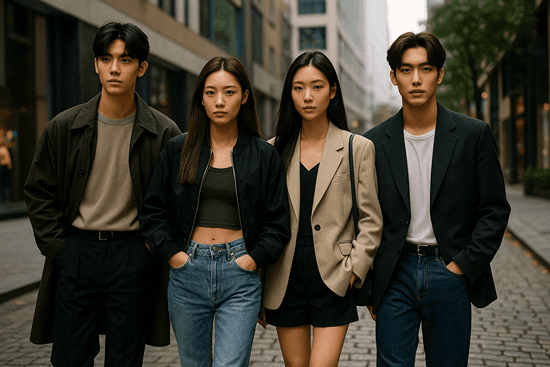
Dongdaemun: The Midnight Engine
~30,000 shops and 20,000 manufacturers, handling roughly 35% of domestic apparel wholesale (Seoul Jung-gu, 2024). Each night, about 6,000 buyers from Asia and the Middle East trade USD 10–12M. Sketch-to-shipment in ~72 hours is not a legend but a logistics discipline.
Speed is not hurry; it’s choreography — samples, trims, cutting rooms, couriers. The ecosystem makes “trend” a timed performance.
Algorithmic Taste, Human Craft
MUSINSA (~USD 2.8B valuation) and ZIGZAG (~4M MAU) convert billions of clicks into SKU decisions. After major K-Pop events in Paris, overseas conversion lifts ~+18% within 48 hours (KOTRA Fashion Desk, 2024). Designers now parse sentiment dashboards alongside swatches: art tuned by analytics.
Green is the new luxury. By 2025, 40% of export-oriented labels aim for certified sustainable materials (MOTIE). In the EU, carbon labels correlate with higher repeat purchase — sustainability as market access, not just messaging.
“K-Fashion wins when emotion meets execution.”
Try Korea. Wear the Story.
Every stitch tells where culture meets precision. From Seoul’s midnight markets to global runways, K-Fashion invites you to wear the rhythm — not just watch it.
이제 한국에 와서, 한국의 스타일을 입어보세요. 트렌드가 아닌 이야기를 입는 경험
— 그것이 K-패션입니다.
References
- KOTRA (2024), Export Trends in Korean Apparel & Lifestyle
- Jin, F. et al. (2024), Sustainability (MDPI) — Hallyu Index & consumer-goods exports
- CICI Foundation (2025), K-Style & Global Perception Survey
- Seoul Jung-gu Office (2024), Dongdaemun Trade Statistics
- Business of Fashion (2025), Global Markets: Korean Fashion
- MUSINSA & ZIGZAG figures (via KOTRA Fashion Desk, 2024)
- MOTIE (2025), ESG Transition Report for Export Industries