

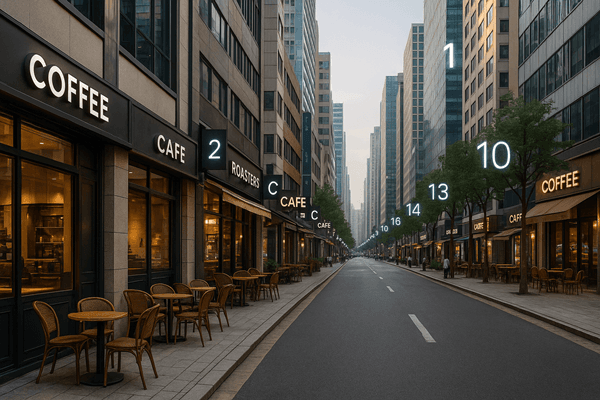
Korea Coffee Landscape
Why Are There So Many Cafés in Korea?
A Data-Driven Look
왜 한국엔 카페가 이렇게 많을까? 데이터로 보는 커피 산업
10M+ population per ~1,500 cafés, 405 cups per person a year. Here’s the market—by the numbers.
인구 100만 명당 약 1,500개, 1인당 연 405잔. 숫자로 정리한 한국 커피시장입니다.
Coffee shop count (2022)
국내 커피전문점 수 (2022)
100,729 ~ 107,729
≈2× since 2016 (51,551).①
2016년(51,551) 대비 약 2배.①Revenue & Employment (2022)
매출 & 종사자 (2022)
₩15.5T · 270K people
Small(1–4): 84K, Franchised: 26K.②
소상공 8.4만, 가맹 2.6만.②Per-capita consumption (2023)
1인당 연간 소비량 (2023)
405 cups
Global avg ≈ 152 → Korea ≈ 2.7×.③
세계 평균(≈152잔) 대비 약 2.7배.③
Market outlook
USD 7.6–12.1bn by 2030
Coffee/Specialty CAGR ≈ 7.3–9.5%.④Scale — How big is it?
- Shops: 100,729–107,729 (’22), +~2× vs ’16.①②
- 점포: 100,729–107,729(’22), ’16 대비 2배 수준.①②
- Density: ~1,500 cafés / 1M people (’21), far above JP/UK/US.⑤
- 밀도: 인구 100만명당 ≈1,500개(’21), 주요국 대비 월등.⑤
- Revenue/Jobs: ₩15.5T & 270K workers (’22).②
- 매출/고용: 15.5조원, 27만명(’22).②
* Figures vary by compilation; we present ranges when media/government tallies diverge.
Quick infographics (inline)
Shops: 2016 → 2022 growth
Cups per capita: World 152 → Korea 405
Why so many? — Structural drivers
- Lifestyle lock-in: coffee = daily ritual (AM commute / post-lunch / dessert).
- 라이프스타일 고착: 출근·점심·디저트 타임에 커피가 일상화.
- Low entry barriers: small take-out formats & franchise support.②
- 진입장벽↓: 테이크아웃 특화 소형점·가맹 동시 확산.②
- Consumer bifurcation: value brands ↔ premium/specialty both rising.④⑥
- 소비 분화: 저가/프리미엄(스페셜티) 동시 성장.④⑥
- SNS-worthy spaces drive dwell time & repeat visits.
- SNS/공간성이 체류·재방문을 유도.
Saturation & risks
- Sales softening: 2025 Q1 café avg −3.2% (KCD panel).⑧
- 매출 둔화: 2025년 1분기 평균 −3.2%.⑧
- Cost pressure: beans, labor, rent ↑ → margin squeeze.
- 원가 압력: 원두·인건비·임대료 상승 → 이익률 압축.
- Over-clustering: overlapping trade areas dilute traffic.
- 과밀 경쟁: 상권 중첩으로 내점객 분산.
Operator checklist
| Item | Guide | Status |
|---|---|---|
| COGS ratio 매출원가율 | < 35% | Monitor 모니터링 |
| Fixed costs 고정비(임차·인건) | Rent+Labor < 30% | Watch 주의 |
| Repeat rate 재방문율 | ≥ 40% monthly | Good 양호 |
Local data → local decisions; variance across districts is large.
Growth pillars
- Specialty: USD 1.47 → 2.51bn (’24→’30), ~9.5% CAGR.④
- Organic & traceability demand rising.⑥⑨
- 유기농/추적성 수요 증가.⑥⑨
- Pods/Home café: USD 1.68 → 2.41bn (’24→’30).⑦
Outlook snapshot
| Segment | ’24/’25E | 2030E | Note |
|---|---|---|---|
| All Coffee | ~USD 7.6bn | ~USD 7.6–12.1bn | 7.3% CAGR range④ |
| Specialty | USD 1.47bn | USD 2.51bn | ~9.5% CAGR④ |
| Pods | USD 1.68bn | USD 2.41bn | ~6.1% CAGR⑦ |
Different houses → different baselines; we cite ranges.
One-liner insight
“Ultra-dense coverage and premium bifurcation—at the same time.”
“초고밀 보급과 프리미엄 분화가 동시 진행.”
Easy entry, hard survival: product, experience, and operations decide winners.
진입은 쉽지만 생존은 어려움: 제품·경험·운영 정교화가 승부처.