

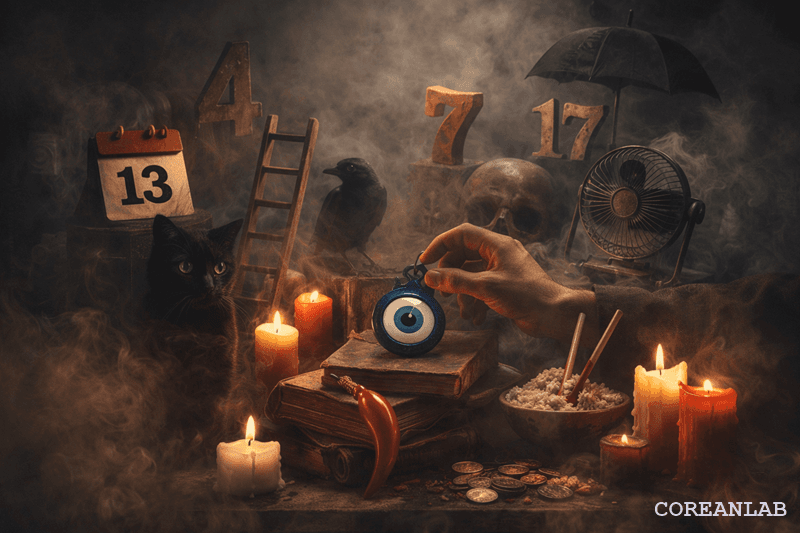
GLOBAL CULTURE · Beliefs & Rituals
Superstitions Around the World
Famous beliefs by country — and what they reveal about fear, risk, and daily life
나라별 “유명한 미신” 모음 — 그 사회가 두려워한 것의 흔적
Superstitions are easy to mock — until you realize they appear in every society, including highly modern ones. The real question is not “Who believes?” but “What uncertainty are they trying to manage?”
미신은 비웃기 쉽지만, 사실상 모든 사회에 존재한다(첨단 사회도 예외 아님). 중요한 건 “누가 믿느냐”가 아니라, “어떤 불확실성을 관리하려는가”다.
Superstitions aren’t random. They are cultural shortcuts for controlling anxiety.
미신은 랜덤이 아니다. 불안을 통제하기 위한 문화적 ‘지름길’이다.
A simple way to understand superstitions
- Numbers: control luck through symbols / 숫자: 상징으로 운 관리
- Speech: words can “invite” outcomes / 말: 말이 결과를 부른다
- Thresholds: doors, stairs, corners / 경계: 문턱·계단·모서리
- Jealousy: fear of envy and attention / 질투: 시선과 부러움의 공포
- Death rituals: don’t imitate funeral gestures / 장례: 장례 행동을 일상에서 금기
Once you see the pattern, every “weird rule” starts to make sense.
패턴이 보이면, 이상해 보이던 규칙들이 갑자기 이해된다.
South Korea
- Fan death — sleeping with an electric fan on is “dangerous.”
- Writing names in red — avoids death-record symbolism.
- No seaweed soup before exams — “slippery” = fear of slipping up.
Korea’s superstitions often cluster around failure, death symbolism, and technology anxiety. Even when people don’t literally believe, they avoid it because “why risk it?”
한국의 미신은 대체로 실패·죽음 상징·기술 불안을 중심으로 생긴다. 진짜로 믿지 않아도 “굳이 리스크를 만들 필요 있나?”라는 심리로 회피한다.
Japan
- Numbers 4 & 9 — avoided due to death/suffering sounds.
- Chopsticks stuck in rice — resembles funeral offerings; strong taboo.
- Cutting nails at night — “won’t be there for parents’ last moments.”
Japanese superstitions are often about not crossing ritual boundaries. Many are also “manners-coded”—you don’t do it because it feels socially wrong.
일본 미신은 의식의 경계(장례·금기)를 넘지 않는 데 집중한다. 예절처럼 체화되어 “안 하면 이상한” 규범이 된다.
China
- 8 is lucky — prosperity sound association; used in phone numbers, plates.
- 4 is unlucky — avoided in floors/rooms in some places.
- Choosing dates — weddings/openings often pick “good days.”
In many Chinese settings, luck is something you can engineer: through numbers, dates, and symbolic alignment.
중국권에서는 운을 “그냥 오는 것”이 아니라 숫자·날짜·상징으로 ‘세팅’하는 것으로 보는 시각이 강하다.
India
- Astrology for marriage timing — compatibility and auspicious dates.
- Entering with the right foot — symbolic “good start.”
- Everyday omens — animals/sounds interpreted as signals.
Many Indian superstitions sit inside a larger “cosmic order” framework. They are less like random rules and more like a living system.
인도의 미신은 단편 규칙이라기보다 우주 질서 속에서 삶을 읽는 시스템에 가깝다.
Vietnam
- First visitor of the year — the first person entering can shape the year’s luck.
- No whistling at night — believed to attract unwanted spirits/attention.
- Gift/occasion taboos — certain items imply separation or loss (context matters).
Vietnam’s superstition culture often feels practical: not “I fully believe,” but “I respect the flow.” In dense cities and fast daily life, people lean on rituals to reduce anxiety.
베트남의 미신은 “맹신”이라기보다 “흐름을 거스르지 않기”에 가깝다. 복잡한 도시 생활에서 작은 의식이 불안을 낮춰준다.
Thailand
- Lucky colors by weekday — clothing and accessories often reflect this.
- Head is sacred, feet are low — don’t touch heads; don’t point with feet.
- Auspicious timings — ceremonies often consider timing and blessings.
Thailand blends religious symbolism and daily superstition naturally. The key idea is respect: for body hierarchy, space, and timing.
태국은 종교 상징과 생활 미신이 자연스럽게 섞인다. 핵심은 존중—몸의 위계, 공간, 시간에 대한 존중이다.
Saudi Arabia & the wider region
- Evil eye — envy/attention can cause misfortune; protective phrases are common.
- Avoid “inviting” bad outcomes — speech becomes a protective ritual.
- Left-hand taboos — in some contexts, left-hand use is avoided.
In many Middle Eastern cultures, intention and attention are treated as powerful forces. That’s why blessings and protective phrases show up everywhere in daily speech.
중동권에서는 의도와 시선이 현실에 영향을 준다고 느끼는 문화가 강하다. 그래서 일상 언어 자체가 ‘보호 장치’처럼 작동한다.
- Nazar amulet — the blue eye charm is everywhere: homes, cars, baby items.
- Night taboos — certain actions at night are “symbolically dangerous.”
Turkey is a great example of superstition as design: objects are used to “guard” daily life.
터키는 미신이 ‘생활 디자인’처럼 쓰이는 대표 사례다. 부적은 장식이 아니라 보호 장치다.
Europe & the Nordics
- No early congratulations — celebrating too early “invites” failure.
- Threshold manners — symbolic boundaries matter in some contexts.
- Friday the 13th — still culturally sticky.
Even in rational societies, superstition survives where the future feels fragile.
합리적 사회에서도 미래가 불안정하게 느껴지는 영역에서는 미신이 남는다.
- Don’t place bread upside down — old symbolism tied to misfortune.
- Salt rituals — small gestures to “undo” bad luck.
France often treats superstition with ironic distance—yet many habits remain.
프랑스는 “안 믿는 척”하지만, 습관으로 남아 있는 미신이 꽤 많다.
- No handshakes across a doorway — boundaries/threshold taboo.
- No opening umbrellas indoors — classic symbolic bad luck.
In the Nordics, superstition often shows up as “small polite rules”—not loud belief.
북유럽 미신은 거창한 믿음이 아니라 “작은 생활 규칙” 형태로 남는다.
- Sit quietly before departure — a reset ritual to avoid accidents.
- No whistling indoors — “money will leave the house.”
These rituals act like psychological brakes in a world that feels unpredictable.
이런 의식은 불확실한 세계에서 ‘심리적 브레이크’ 역할을 한다.
Superstitions are not “lies people believe.”
They are “fears people learned to manage.”
미신은 ‘거짓 믿음’이 아니라, 사람들이 두려움을 관리해온 방식이다.