

The Second-Hand Surge in Korea
– Trading Value, Not Just Things
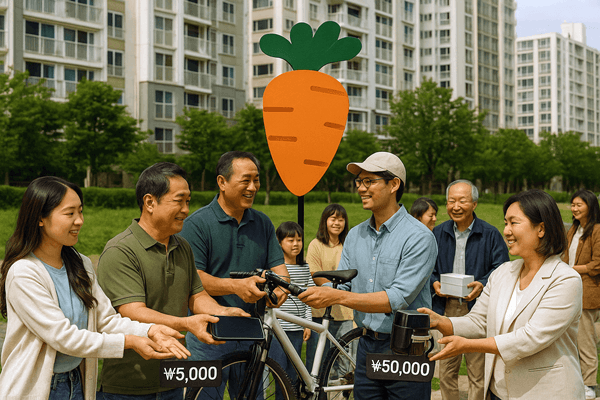
절약에서 공유로, 한국의 중고거래는 소비 문화를 다시 쓰고 있다.
From thrift to lifestyle
In Korea today, buying used isn’t just about saving money – it’s become a lifestyle, a social statement, and even a local economy. Apps like Danggeun Market (Karrot) and Bunjang have turned second-hand trade into a cultural phenomenon connecting millions of neighbours.
절약에서 라이프스타일로
오늘날 한국에서 ‘중고거래’는 단순한 절약이 아니라 하나의 문화이자 지역경제가 되었다. 당근마켓, 번개장터 같은 플랫폼은 이제 수백만 명을 연결하는 생활 네트워크로 진화했다.
Market Landscape · 시장 현황
Korea’s second-hand market has grown rapidly — estimated at ₩24 trillion in 2021, it reached about ₩26 trillion by 2023 and is projected to exceed ₩40 trillion by 2024–2025. This growth outpaces most retail sectors, fuelled by trust-based mobile platforms and eco-conscious consumers.
한국의 중고거래 시장은 빠르게 성장하고 있다. 2021년 약 24조 원 규모에서 2023년 26조 원을 기록, 2024~2025년에는 40조 원을 돌파할 것으로 전망된다. 신뢰 중심의 모바일 거래와 가치소비 확산이 주요 동력이다.
Cultural Shift · 문화적 전환
The zero-waste mindset and mobile-first lifestyle reshaped how Koreans perceive used goods. Platforms evolved from person-to-person sales into full-fledged local community marketplaces — where users exchange not only goods, but also trust, recommendations, and stories.
제로웨이스트와 모바일 중심 생활방식은 ‘중고’에 대한 인식을 바꿔놓았다. 이제 플랫폼은 단순한 거래 공간이 아니라, 지역 커뮤니티 마켓플레이스로 발전했다. 물건뿐 아니라 신뢰, 정보, 이야기가 함께 오가는 공간이 되었다.
Global Context · 글로벌 비교와 차별성
Korea’s success in second-hand platforms isn’t simply about technology — it’s about social infrastructure. While the U.S. had Craigslist and Facebook Marketplace, and Japan had Mercari, few matched Korea’s trust, localization, and integration. Korea found a balance: digitally hyper-local yet socially human. Verified neighbourhood transactions, real-name systems, and proximity-based maps built a “trust loop” that became both a social and an economic network.
한국의 중고거래 플랫폼이 성공한 이유는 단순한 기술이 아니라 ‘사회적 인프라’ 덕분이다. 미국의 크레이그리스트, 페이스북 마켓플레이스, 일본의 메루카리 등도 존재했지만 신뢰·지역성·실생활 결합도 면에서 한국형 모델이 가장 정교하게 작동했다. 한국은 ‘디지털은 하이퍼로컬, 문화는 휴먼터치’라는 균형을 잡으며 실명제·지도기반 거래로 ‘신뢰 루프(Trust Loop)’를 형성했다.
| Country | Platform | Limitations | Korea’s Differentiation |
|---|---|---|---|
| 🇺🇸 USA | Craigslist, FB Marketplace | Anonymous, safety issues | Verified, local, humanized trade |
| 🇯🇵 Japan | Mercari | Retail preference, low local exchange | Community-driven, map-based |
| 🇪🇺 Europe | Vinted, eBay Kleinanzeigen | Product-centric, limited social value | Trust-centered community model |
| 🇰🇷 Korea | Danggeun, Bunjang | — | “Local to Local” (L2L) economy |
Strategic Implications · 산업적 의미
-
For brands: Second-hand channels are no longer threats but extensions of retail ecosystems.
For start-ups: The next frontier lies in verification, logistics, and local trust networks.
For global markets: Korea’s “used-as-lifestyle” model could inspire circular economies abroad.
-
브랜드에게: 중고거래는 위협이 아닌 유통생태계의 확장으로 인식된다.
스타트업에게: 다음 기회는 검증·물류·신뢰 기반 네트워크에 있다.
글로벌 시장에게: 한국의 ‘중고=라이프스타일’ 모델은 순환경제의 레퍼런스가 될 수 있다.
Outlook · 전망
“성장은 멈추지 않는다. 단지 모양이 바뀔 뿐이다.”
The next phase of Korea’s resale boom will merge local trust + global scalability + sustainable design. The future of used goods is not about ownership — it’s about connection and story.
한국 중고거래의 다음 단계는 지역신뢰 + 글로벌 확장 + 지속가능 디자인의 융합이다. 중고의 본질은 이제 ‘소유’가 아니라 연결과 이야기에 있다.
“Korea made second-hand goods more than trade — it made them a culture.”
“한국은 중고거래를 거래가 아닌 문화로 만들었다.”
© CoreanLab Magazine · Industry & Culture Edition · 2025