

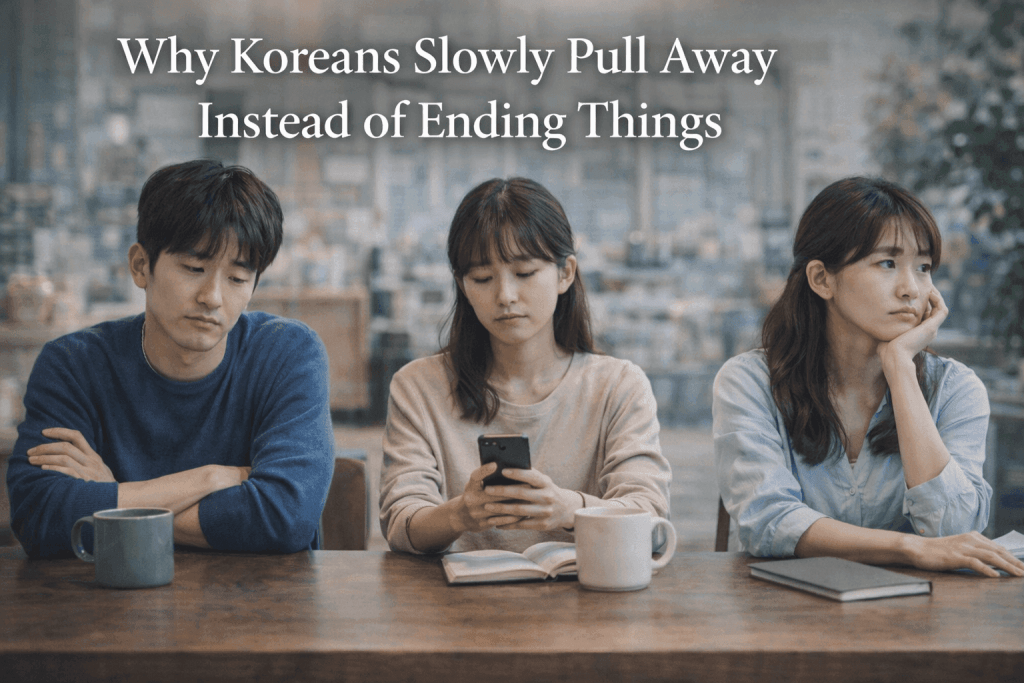
Why Koreans Slowly Pull Away Instead of Ending Things
In many Korean relationships, endings are not always announced. Sometimes they’re communicated through distance—quietly, gradually, and without a final speech.
It doesn’t end with a breakup conversation. It ends with… a change in temperature.
어떤 관계는 “헤어지자” 같은 대화로 끝나지 않습니다. 대신… 관계의 온도가 바뀌는 방식으로 끝나기도 합니다.
Replies get shorter. Plans become “busy.” Calls happen less. Nothing dramatic happens—until you suddenly realize you’re no longer close.
답장은 짧아지고, 약속은 “바쁘다”로 밀리고, 연락은 줄어듭니다. 큰 사건은 없는데—어느 순간 ‘더 이상 가깝지 않다’는 걸 깨닫게 됩니다.
“Why didn’t they just say it was over?”
This isn’t “all Koreans” and it isn’t a moral judgment. Many people in Korea do end relationships directly.
이 글은 “모든 한국인”을 말하는 것도 아니고, 도덕 평가도 아닙니다. 한국에서도 관계를 직접적으로 정리하는 사람은 많습니다.
But there is a recognizable pattern—especially in early dating, friend groups, and workplace-like social circles: when the cost of confrontation feels high, people sometimes choose distance over declaration.
다만 특히 연애 초반, 친구 관계, 그리고 ‘관계가 얽힌’ 사회적 모임에서는 대립의 비용이 크다고 느껴질 때 선언 대신 거리두기를 선택하는 패턴이 관찰되곤 합니다.
Why “Pulling Away” Can Feel Like the Safest Exit
A direct ending can trigger blame, emotional conflict, or “What did I do wrong?” debates.
직접 정리하면 비난, 감정 충돌, “내가 뭘 잘못했어?” 같은 대화가 커질 수 있습니다.
Friends, coworkers, communities—relationships often share the same spaces.
친구, 직장, 모임 등 관계가 같은 공간을 공유하는 경우가 많습니다.
Keeping the surface calm can feel more “polite” than an honest but heavy conversation.
솔직하지만 무거운 대화보다, 겉을 매끄럽게 유지하는 것이 더 예의처럼 느껴질 때가 있습니다.
핵심: 어떤 상황에서는 직접 정리하는 것이 ‘민폐’나 ‘분위기 파괴’처럼 느껴질 수 있습니다.
The “Slow Fade” Has a Pattern
Pulling away usually isn’t random. It often follows a predictable sequence—small changes that feel harmless on their own.
거리두기는 대체로 랜덤하지 않습니다. 작은 변화들이 단계적으로 쌓이며 흐름이 만들어지는 경우가 많습니다.
Same words, slower replies. Less warmth.
말은 비슷하지만 답장이 느려지고 온도가 낮아집니다.
Not a clear “no,” but repeated postponing.
명확한 거절 대신 “바빠”로 계속 미뤄집니다.
They stop sharing details. Conversations stay surface-level.
사적인 얘기가 줄고 대화가 겉돌기 시작합니다.
Not a breakup—more like a gradual “off switch.”
이별이라기보다 ‘서서히 꺼지는’ 느낌입니다.
Three Contexts Where This Happens the Most
When the relationship feels “not official,” a formal ending can feel unnecessary or too intense.
관계가 애매한 초반일수록 ‘공식적인 정리’가 과하다고 느껴질 수 있습니다.
Korean friendships often protect group harmony; confrontation risks splitting the circle.
친구 관계는 집단의 균형을 중시해, 대립이 모임을 갈라놓을 수 있습니다.
If you share mutual friends, communities, or work networks, distance can avoid awkward ripple effects.
지인·커뮤니티·직장 네트워크가 겹치면, 거리두기가 후폭풍을 줄이는 방법이 되기도 합니다.
What Foreigners Often Misread
In Korea, silence can be a message. A lack of confirmation can be the answer.
한국에서는 침묵이 메시지일 수 있습니다. 확답이 없다는 게 답이 될 수 있습니다.
Busy happens. But repeated “busy” + reduced warmth is a pattern.
바쁠 수는 있지만, ‘반복되는 바쁨 + 온도 하락’은 패턴입니다.
Direct questions can raise pressure, triggering more distance instead of honesty.
직접 질문이 오히려 압박이 되어, 솔직함 대신 거리두기를 강화할 수 있습니다.
Sometimes it’s not cruelty—it’s conflict avoidance + risk management.
때로 잔인함이 아니라, 갈등 회피 + 리스크 관리일 수 있습니다.
How to Respond Without Making It Worse
Look at patterns, not single moments.
One late reply is nothing. Three weeks of distance is a signal.
한 번이 아니라 패턴을 보세요.
한 번 늦은 답장은 문제 아니지만, 몇 주간의 거리감은 신호일 수 있습니다.
Offer a low-pressure exit.
“If you’re busy these days, no worries. We can keep it light.”
부담 없는 출구를 열어주세요.
“요즘 바쁘면 괜찮아. 가볍게 하자.”
Give space once, then observe.
Space can reduce pressure and reveal the real direction.
한 번은 공간을 주고 지켜보세요.
압박이 줄면 관계의 실제 방향이 더 선명해질 수 있습니다.
Push for a courtroom-style conclusion.
“Tell me exactly what I did wrong. Right now.”
재판처럼 결론을 강요하지 마세요.
“내가 뭘 잘못했는지 지금 정확히 말해.”
핵심: 한국에서는 ‘말’보다 ‘행동’으로 정리가 되는 경우가 많습니다. 행동이 계속 멀어진다면, 말이 오지 않을 수도 있고—그게 답일 수도 있습니다.
This Is the Same System You’ve Seen Before
If you read the previous episodes—about silence, indirect “okay,” and the safety of doing nothing— this pattern fits perfectly.
이전 편(침묵, “괜찮아요”의 간접성, 무행동의 안전성)을 읽었다면 이번 패턴도 같은 구조 안에 있습니다.
Final Thought
The slow fade can feel painful—especially if you come from a culture where closure is spoken. But in Korea, closure is sometimes delivered quietly: through reduced access, reduced warmth, and reduced availability.
말로 정리하는 문화에 익숙하다면, 서서히 멀어지는 방식은 특히 더 아프게 느껴질 수 있습니다. 하지만 한국에서는 때로 ‘정리’가 조용히 전달됩니다. 접근성·온도·가용성이 줄어드는 방식으로요.
Sometimes it’s simply… allowed to happen.